 01233 740529


Special Offers
Redeem Offer Code
Redeem Gift Voucher
Scarecrow Members

Our Feedback
I just want to say what marvellous beetroot and sprout plants you sent me. I have never got such good plants from other suppliers.
John Horne, Barnet
Close Social & Offers
Special Offers
Redeem Offer Code
Redeem Gift Voucher
Scarecrow Members
Our Feedback
I just want to say what marvellous beetroot and sprout plants you sent me. I have never got such good plants from other suppliers.
John Horne, Barnet
Goji Berry Plant
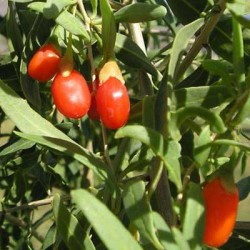


Lycium barbarum
- First introduced to the UK in the 1600's, so not quite the new superfruit that many believe they are!
- Fresh fruit is gorgeously sweet.
- Easy to grow and can even be used for hedging.
- Will reach 8 - 10 feet (2.4 - 3 metres) tall by 5 feet (1.5 metres) wide.
Supplied as potted plant approximately 8" - 10" (20 - 25 cm) tall including pot
Available from APPROXIMATELY late April / early May1 or more £8.95GBP each. Group & quantity discounts
Currently Not Available to Buy
Description
Whilst some may pretend Goji Berries are new to the UK and a secret to the Western world it is well documented that Goji's were first introduced to the UK in the 1600's. The name 'Goji' is fairly new and is based on the Chinese name 'Gou Qi Zi' - before this it has been known as The Chinese Wolfberry, The Matrimony Vine, The Chinese Boxthorn, The Red Medlar and even The Duke Of Argyll's Tea Tree. Surprisingly it is known to be a naturalised specie in the UK, being found in hedgerows in some parts of the Country.
What has only recently been brought to the attention of much the UK populace is the purported wonderfood status of this berry, and to this end below we detail below some of the truly miraculous medicinal benefits of the Goji Berry.
Forgetting all the health benefits of Goji's, they are a lovely fruit. Eat them fresh (shake them from the plant to prevent your hands oxidising them and making them go black), or dry them and eat them like sweets or add them to muesli to make your breakfasts power packed. You can even infuse them into a refreshing (and healthy) tea.
According to folklore, people living in the Himalayas who eat Goji Berries are reputed to live to between 120 and 150 years old! The famous Li Quing Yuen is said to have lived to over 250 years, and ate Goji berries on a daily basis. We cannot of course promise you such longentivity!
An ancient account of the wonderful Goji
Amazed at the magic of the Goji the merchant bowed to the lady with respect and asked, "may I be so bold as to ask what magical herb you posses?"
The lady replied, "this herb has five names. You want to take a different part of the herb each season...
In Spring you take its leaves, which are known as the Essence Of Heaven.
In Summer you take its flowers, which are known as the Longevity of Life.
In Autumn you take its fruits, which are known as the Chinese Wolfberry.
In Winter you take the bark of its root, which is known as the skin and bone of the Earth, or the Staff of the Almighty Creator.
Taking these four parts in the four Seasons respectively will give you life as lofty as Heaven and Earth."
- Self fertile.
- Hardy to all extremes of climate -15°C to 40°C.
- Drought tolerant.
- Will reach 8 - 10 feet (2.4 - 3 metres) tall by 5 feet (1.5 metres) wide.
- A single plant should produce over 2lbs (1kg) of berries after approximately four years.
- Small purple and white trumpet flowers in Summer are followed by small oval berries that are orange red in colour; these can be harvested until the first frosts.
- It is better to shake the berries from the plant rather than picking by hand as this will cause the fruit to oxidize and become black in colour.
- Young plants need to be over-Wintered in a cold greenhouse / light airy window sill.
- Plant out in Spring (May/June time at the earliest, when the night time temperatures are warmer) and Summer.
- Prefer full sun or partial shade.
- Require a well drained, not too rich soil. In some parts of the world they have been used as soil stabilisation plant.
- They will not tolerate heavy, wet soil.
- If planting more than one allow a minimum of 6 - 8 feet (1.8 - 2.4 metres) apart.
- Dig the ground over well and incorporate some organic matter such as well rotted manure (not fresh) or compost to give your plant the best start.
- Plant to the level the plant has been grown; firm in well and water if soil is dry.
- Under no circumstances should you use any stimulants, fertiliser or bonemeal at planting time as such products will 'burn' any new root growth and actually slow your plant's development.
- In the first growing season after planting it is vital to ensure the plant is adequately watered - and this is even more critical in extended dry periods or drought. When watering any newly planted stock a 'heavy soaking' once a week is favourable to a 'light shower' every day, and will encourage a good deep root system.
- Keep the area around the base of your plant free of weeds and grass which would otherwise compete for both moisture and nutrients.
- Once established they are wind tolerant and salt wind tolerant.
- Once establishedthey will prove frost hardy to at least -15°C but will similarly survive temperatures as high as 40°.
- Under no circumstances be tempted to overfeed.
- Pruning is best undertaken in the early Spring just as the plant breaks into growth. We would recommend pruning is kept to a minimum in order to maximise fruit yield - though Goji's will recover well from hard pruning.
- Container Growing.
- Can be grown in patio tubs or containers and should ideally be allowed to grow to a minimum height and width of around 3ft - 4ft (0.9 - 1.2 metres) in order that they can produce a worthwhile crop.
- Do not over pot your Goji plantas this may cause your plant's roots to become waterlogged.
- Pot up into a container just one or two sizes larger and allow the plant to fully root out before re-potting into the next size up - continuing until you have reached your final chosen size of container.
- Any proprietary potting compost will be fine though we would always recommend the addition of a little horticultural grit to improve drainage, particularly if you choose to use a soil based compost such as John Innes or similar.
- Long-term the ideal size of container would be something like a half-cut wooden barrel or similar.
- Good drainage is essential. Holes should be made in the base, and possibly in the sides at the base as well.
- Avoid standing the container where it will become waterlogged.
- Ideally the container should be stood on a couple of house bricks or gravel to assist drainage.
- A little brick mortar rubble in the bottom of the container to cover the drainage holes and to stop the soil falling through is recommended.
- After their first full growing year, container grown plants should prove perfectly hardy and can be left out all year round - that said, as with anything container grown, Winter protection will improve Spring growth and ultimately yield.
- Medical Uses.
- Can lift your mood and make you feel happy!
- Full of essential nutrients.
- Can help protect against eye disease.
- Has anti-bacterial properties.
- Is said to have an anti-leukaemia compound within it.
- Will enhance immunity.
How To...
How To Grow Exotic Fruits
Basic guidance on how to plant and growing exotic fruits including Loquats, Citrus, Pineapple Guavas, Olives, Pomegranates and Passion Fruits.