
Victoriana Nursery Gardens - For Quality Seeds and Plants RHS Silver Medalists
Main Navigation
HomeAbout UsVisiting UsContact UsTrading PolicyCatalogue RequestFeedbackCarriage ChargesLinksSitemap
Home \ About Us

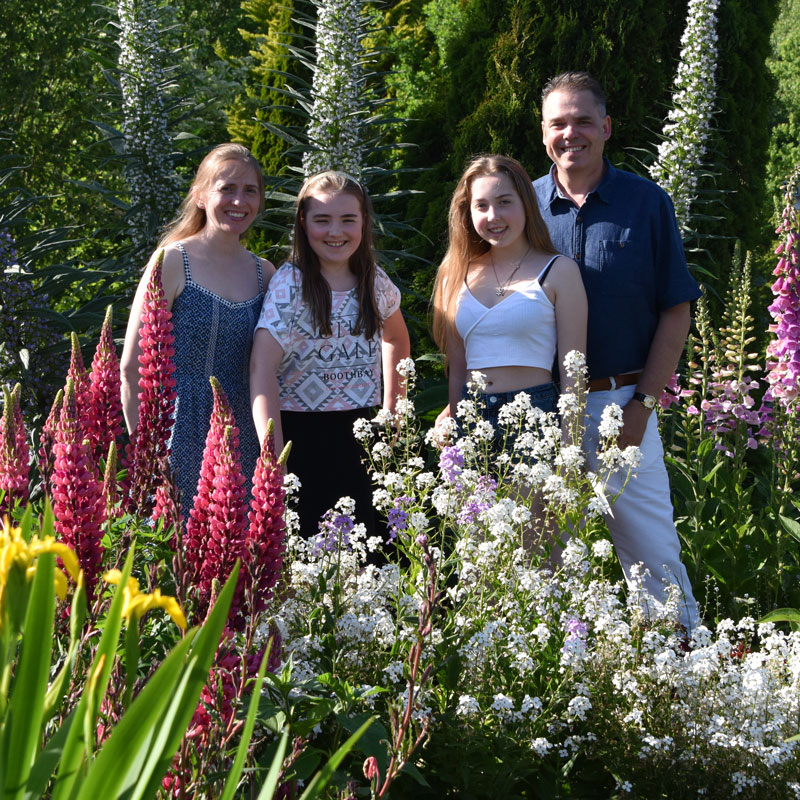
The Shirley Family And A Few Of The Team Who Didn't Escape The Camera

About Victoriana - Who's Who & What We Do

Some people have green fingers, fewer have green in their blood, fewer still have green genes! For two generations, Victoriana Nursery Gardens have been supplying superb plants to the Nation’s gardeners, with that extra touch – passion.

The driving force behind the nursery is the Shirley family; two generations of them who, from children Molly and Milly (6 and 4yrs) to Stephen and his wife Serena to father Jeremy and his wife Joan, are all passionate about gardens - and the very best plants to put in them.

What’s different about Victoriana Nursery Gardens? Apart from superb and interesting plants such as Strawberry Popcorn or Victorian Colossal Climbing Peas (old fashioned peas that grow so tall you’d think they were magic) there is sheer enthusiasm.

It is no mistake that when you buy their plants they arrive packed so carefully that even if they have travelled hundreds of miles, they’re still perfect on arrival. They just love what they are doing, and in the gardening world that means green fingers, toes and whatever else you care to mention.
Paul Peacock – Author, Broadcaster and the new ‘face’ of Mr Digwell for The Daily Mirror

Here at Victoriana we think we are uniquely different and some might even go as far as saying odd ! Well odd but happy is fine by us! Victoriana Nursery Gardens is the distillation of the Shirley family's many years experience of serving the gardeners of the United Kingdom. The Shirley family tree reveals that way back in the early 1700's a branch of the family were seed merchants.

Jeremy and Joan Shirley started their first mail order nursery, in Surrey originally, in 1958 - but moved to Challock in 1963. Whilst they describe themselves as 'recycled teenagers', and one or two people affectionately call Jeremy ‘the old codger’, they still contribute much to the day to day work on this busy family nursery.

Their son Stephen joined the family business in 1985 on leaving school and now heads up the team with his wife, Serena, who joined in 2004. Stephen and Serena’s children, Molly (6) and Milly (4), also now take a very active role and help out wherever and whenever they can.

But that is not the end of ‘the family’ as all who work on the nursery are part of the ‘extended family’; together we make a close nit group. Growing plants and the nursery is a way of life, not just a job! Coffee break at 10.30am every day is a time when we all get together for a natter, with birthdays and such celebrated with cake, for some reason we have a lot of July birthdays – so there’s lots of cake in July! All in all we're a friendly bunch, happy in what we do and with a genuine pride in what we produce.

So What Do We Grow?

With just over fifty years experience of supplying seeds and plants to the Nation's gardeners it really is true to say we are passionate about gardens and gardening! Unlike some web-based mail order 'nurseries' and 'seed merchants' we actually grow most of what we sell - rather than simply acting as a distribution house for bought in goods - and what's more we welcome visitors. Our visiting us page will help you with directions and opening times.

Visitors to our nursery and plant centre (we are proudly not a garden centre) will find an even wider range of plants than we offer by mail order including ornamental trees, shrubs and herbaceous plants. Of course, all the items we sell by mail order are also available for collection.

In the Summer months our Display Vegetable Garden, tended by Brian Gray under the careful guidance of Jeremy Shirley can prove of interest and inspiration to both novice and accomplished gardener alike. Each year we grow the bulk of our vegetable range, both for seed production and to feed us all. And of course we trial new varieties with a view to introducing to our range - if we all agree they're good enough! As we genuinely know the growing habits and flavours of what we sell we are confident we can best advise our customers.

In 2008 Mark Couling took over tending our small raised herb garden and has since planted up the surrounding borders with ornamentals and perennials from our Cottage Garden range of plants. This little area is hidden on one side by our Jerusalem Artichoke plantation and on the other by our Willow hedge – the only way in is through the willow arch - and so has become known as Mark's Secret Garden.

Similarly during the Summer our Fuchsia house can be quite a picture with Joan Shirley's personal collection of over 600 varieties on display, many of which are of course available to purchase.

Each year we try and do a little more to give further interest for our visitors. For the past few years we have been planting short lengths of our various hedging subjects so that our visitors can see mature examples. A large orchard area was also planted up though a combination of rabbit damage, a few lost labels and a change of design plan means replanting will be a project for Winter 2009 / Spring 2010.

We really are a growing business with a genuine passion for what we do.

As we have said before... a way of life!

Are Victoriana Organic?

To answer this question one first has to ask the most basic question of all - what is organic?

Look up organic pesticide on a search engine such as Google (research last checked 18/02/07) and not only will you get results for natural methods of pest control but you will also find DDT listed there - why? Because scientifically speaking DDT is an organic compound! Our simple comment to this (and it has been for many years since Mr Shirley senior first started writing for Chase Organics in the 1950's) - is organic the correct word for produce grown or reared without the use of nasty chemicals or artificial fertilisers?

We do not in any way wish to upset the likes of The Soil Association, Garden Organic (formerly The Henry Doubleday Association (HDRA)) or any other similar organisation or publication - but this really does need thinking about! What we in the United Kingdom may consider to be the definition of organically produced is not necessarily the same definition accepted by others around the world, perhaps even in some parts of Europe - something that should perhaps concern us all considering the amount of imported 'organic' produce.

Whilst we do not hold any formal organic certification or recognition we ask you to draw your own conclusions:
The land upon which Victoriana Nursery Gardens is built and upon which we grow our produce has been in the Shirley family's ownership since 1972 and during that time we have never used any chemical pesticide, fungicide or artificial fertilisers. Put simply we have never used any 'nasties' and never will. Prior to our ownership the land was owned by a local farmer and used for cereal crops - and similarly we are not aware anything of a noxious nature was used during his and his forefathers ownership.

Our water supply to the nursery is drawn from a borehole 130 metres deep (450 feet) so even the water we nurture our plants with is as natural and pure as it can be (the Environment Agency test our borehole at least four times a year).

We are proud of the abundance of nature we have on the nursery - from the welcome frogs, toads, newts (including crested), slow worms, lizards, bats and a diverse range of birds to the less than welcome mice, rabbits and pigeons! Even more important is the fact that we can (as can the younger members of the family) pick and eat any of our vegetables or fruit we grow on the nursery safe in the knowledge that it is entirely natural. And this is probably one of the most important things about growing your own produce.

How It All Began

As we’ve previously mentioned, our family’s roots in horticulture can be traced back as far as the 1700’s – but that is probably a little too much history to recite! And so we shall start our history from when Jeremy Shirley first took an interest in horticulture.

The Land Purchased By Jeremy and Joan In 1963, And What It Became

1943-1973 - From Childhood Entrepreneur To Nurseryman

(This text has been extracted from the book ‘Escapism’ which was written during the postal strike of 1973 – in those days before the likes of credit cards, telephone ordering and of course the internet the postal strike meant mail order sales ceased and so Jeremy had time on his hands to write a book!)

I have mentioned in various parts of this book, or rather indicated that I started growing plants as a kid. In actual fact, my interest in gardening and nature, began when I was about nine years of age, it is true to say that in my early youth, horticulture proved my most absorbing hobby. I used to keep the most enormous Cactus in my bedroom, together with green lizards, much to my mother’s concern, as well as breeding goldfish and white mice.

As a child I was living at Chestnut Grove in Isleworth in Middlesex, and found that I had a surplus of plants and mice and, accordingly, these used to be taken on the ‘trolley bus’ to the local pet shop, and a few ‘shillings’ earned here and there. My parents were keen amateur gardeners and were by no means professional.

They just liked the garden to look nice, as most people do. They had made a large garden pond that produced a surplus of aquatic plants that were, or so I found, in great demand, at 2d a strand (old pence)! I don’t know when I thought of commercialising on my hobby, it just seemed to happen, and eventually, I had sold sufficient aquatic plants to enable me to buy a second hand bicycle, and eventually, I saved up for a motorbike. On leaving school I choose to take horticulture as a career. Apart from taking Botany and Zoology, at Spring Grove Polytechnic in Isleworth, I took no other theoretical work. Educationally, I was not up to the standard to go to University, and I am pleased in the circumstances and position that I find myself today, that I did not! Instead I choose the only opportunity that seemed to be open to me, and this was to take a practical career with a number of leading growers in the country. I remember my first job distinctly was with a firm known as F.A. Secrett, of Bell Farm, Walton on Thames. They have a large market garden holding in Godalming at the time of this book going to press, and my first job was hand washing Leeks in large metal tanks of icy cold water! I did this day in day out for six weeks. I smelt like a Leek, nevertheless, today I like to eat Leeks, although it always reminds me of those early days! I was moved on to various jobs, like cutting Cauliflowers, and Lettuces, and getting a general idea as to how a busy market garden worked. I stayed with the Company for just over two years, and to my parents regret changed my job and had my first insight, as it was, to ornamental horticulture growing, Gardenias, Stephanotis, Chrysanthemums, Tomatoes, Lilies and outdoor flower crops on a nursery in Hampton in Middlesex. Although I reached a managerial position, strange as it may seem, very quickly, possibly because I was very enthusiastic with everything I did, I chose to leave to get even wider horticultural experience! This went on for the next few years. One company I went to gave me the position of Seed Manager, and I found myself writing a newsletter for the United States Organic Gardening Clubs. This ‘brought in’ for that particular company, a large amount of business!

I was now about twenty two years of age and had the title of Seed Manager. My wage was £10 a week! I had a new Lambretta motor scooter, some savings and an interesting job. However, the particular company that shall be nameless, was in a bad way financially. It was then, that I semi-decided to branch out on my own, part time – with my girlfriend, who was nearly eighteen (My wife and co-director of this business today) On an old duplicating machine we ‘printed’ off some seed lists, and I bought packeted seed from a wholesaler in Essex, which I advertised in the classified sections of the gardening magazines. Sales were very poor, and the company with whom I was working found out my girlfriend’s and my side line business, and I was sacked! It was at that stage in my life or career that I thought about getting out of horticulture altogether, and I decided to go into the construction industry, knowing absolutely nothing. I joined one of the world’s leading firms of pre-cast concrete building component manufacturers. I took a management apprenticeship, whilst in my spare time, my girl friend and I grew plants!

After about a year, I saw an Assistant Works Manager job at a concrete factory advertised at Shepperton Middlesex. I applied for the job, and got it with an extremely good salary. By then with my girlfriend’s and my spare time efforts, we had saved for and purchased a bubble car and were seriously thinking about getting married.

We were refused planning permission on a piece of land near Addlestone in Surrey for a home, and as it was at that juncture that my boss offered to sell me one of his properties at Lightwater in Surrey. Needless to say, we were both delighted and managed to scrape together the necessary deposit and get a mortgage with the Local Authority. Everything we had went into that little property in Lightwater. We were married and on return from honeymoon, my boss who had sold me the property, gave me two weeks notice, as the company had been taken over by another organisation from West Drayton in Middlesex! You can imagine how I felt on returning home, with no money in the bank, newly married and no job! My wife’s opinion was completely the reverse to what I thought it would be, and I remember her saying, "That’s good, now you can start on your own". I had then graduated, so to speak to a mini-van.

I had kept up-to-date by way of interest as a hobby in horticulture. I watched the various horticultural trade publications, and knew of a Dutch bulb importer, who offered bulbs at the time, on a sale or return basis. With no assets, I went to see him, took the plunge of getting bulbs packed up into brown paper bags, with pretty pictures on the outside of the bags, and literally hawked them all round the shops in London in my mini-van. At this time, bulbs had only recently come off Government quota and we managed to scrape a living. I started packeting up seeds and selling these by mail order to wholesale growers through the Trade Press. At our home in Lightwater, we built a large greenhouse - the two of us together. despite my knowledge and experience gained in the building industry, after the first week of getting this greenhouse constructed, it blew down in a gale! Nevertheless we put it up again, this time in a blinding snow storm, which went on for days and days, and eventually my wife and I glazed and put every piece of it together ourselves. I started to grow plants on a larger scale, having previously placed small classified advertisements in the Exchange and Mart with a reasonable mount of success. My wife planted up miniature gardens, and these of course were also hawked out of the ‘bulb season’, all over London to many customers that I had established. However it was about this time, that yellow lines started to appear at the kerb-side with their implications of ‘No waiting’ or parking restriction orders. In consequence I was desperate (we now had a baby on the way) to try and do better business. So the first major gamble was made. A classified advertisement costing £21 was placed in the ‘Daily Express’ from a public telephone box. I wouldn’t imagine that one could do this quite so easily today. The initial response was very good, and encouraged us to carry on.

Just as we were getting on our feet at Lightwater, the problems of Town & Country Planning started to wield upon us, for conducting a business from a private residence, and in consequence, we were threatened with an enforcement notice. It was quite obvious that we could not carry on in Lightwater in Surrey and in consequence we searched the agents and countryside for an established horticultural holding or business. It was impossible to try and find a modern holding for we were obviously very short of money. Eventually we found a ramshackle place in 1963. It stood in five acres of scrub and woodland and tumble down poultry huts with a shabby nissen hut for a home. That was the start of Kent Country Nurseries.

We moved in July 1963 and working sometimes fourteen and fifteen hours a day, seven days a week, struggled to pull it into shape, both with roadside sales, mail order and my tour to the City of London, selling little Cactus Gardens and bowls, amongst my established past customers. However, I gradually let this slide, as more and more yellow lines and parking wardens appeared on the scene. We then concentrated our entire efforts into developing the site, into as I term it today, a family ‘Plant Centre’. Needless to say, there are more than just two of us today, and at the time of writing this, the staff, full time staff runs at about sixty in peak season. A nearby farm was purchased in 1969 where shrubs, trees and conifers, and a wide range of stock, in fact, much of the stock offered in this book, is now produced. Since then, we have just added a further ten acres of outside land.

Many problems came in the early days, tremendous adversity both with Local Town And Country planning, and problems still arise. The prolonged postal strike in early 1971 was one of the latter blows, just as we were about to get into our Spring selling season, and the weather amenable for gardening. Right back in the early days in the Autumn 1964 the heating plant packed up and a whole crop of Chrysanthemums in bloom froze solid, due to lack of fuel. It was a job to make ends meet. I can well remember my wife and I literally sat down and cried. But still, we had to carry on. Later problems arrived with power cuts causing heating plant to fail and accordingly, a second-hand generator was purchased to try and overcome this. In recent years this was replaced by a large automatic stand-by generating plant, and what a boon it proved during the coal strike period of 1972, and I know will do so in future years! Power failures are quite common in this part of the world with so many overhead cables. This is very much a country district and often in high winds falling branches from over-hanging trees bring down the power lines!

The business as it is today has been developed out of a hobby and we have surrounded ourselves with a good team of diligent, hard working personnel. The mail order business is very much the life blood of this concern, and many people would be amazed and I am not divulging figures here, of the considerable capital investment that has annually been made to provide modern packing facilities, construction of greenhouses, heating plant, concrete roads, drains, automatic irrigation, office accommodation, machinery etc. It is still developing to try and give you, our valued customer, an expedient and better service. I have always believed, since starting this business, in trying to invoke personal callers, to see the stock, to see this place, that is completely independent of all price rings. I have always endeavoured to find and produce unusual plants.

To those with the courage, even with all the problems of penal taxation and planning controls, I feel it would be possible to duplicate or to start such and enterprise as this again. If one has the ability to think and work hard, mountains can be moved. I must add we have found in recent years the Ministry of Agriculture, Fisheries and Food, very helpful towards us. Remember this business, started originally on a capital of less than ten shillings or fifty pence as it is termed today, with our first advertisement going into the Exchange and Mart costing 6s 8d six shillings and eight old pence with a few garden plants that were available and as I have outlined in Chapter 6.

I hope that you have found a lot of useful information in an easy to read and understandable manner. I am fully aware that there are catalogues and brochures giving long lists of Latin names. To my way of thinking, this conjures up very little interest to those who want to start or to become involved in this delightful leisure pursuit.

I hope that should you decide to visit us or send an order by mail, whether you be professional man or woman, or a vital part of industry, or factory hand, that I have been able to arouse your interest and curiosity! However large or small your order, I will personally try to see that it is met with expedient attention. Meantime Happy Gardening. Happy Escapism!

1973-1985 - Continued Expansion Until Disaster

Due to the major oil crisis that arose in 1973 along with the miner’s strike, to save energy, a three day week was implemented and a government mandate enforced that all lighting was to be cut by 50%, and so for the whole of January 1973 we decided to close our main retail showrooms and install a new lighting system. We doubled the amount of lighting output by using fluorescent tubes that used less energy - yet when cut back by 50% gave the same light intensity as before; this gave the effect of natural sunshine. New display benches were made and two cash points installed for the increasing number of visitors that travelled from far a field to our nursery facing the village green known as Challock Lees.

Also in 1973 we launched a catalogue given over exclusively to seeds under the trading name ‘Saracen Truth Seeds’; this not only included vegetable and flower seeds but also exotics as well as tree and shrub seeds - as we saw a trend developing, particularly for vegetable seeds.

Later during the 1970’s, with a change of government to Harold Wilson’s Labour party, not a week went by without a succession of strikes - postal strikes, newspaper strikes and general malaise – which for the first time slowed down our sales; inflation had reached 12%. Some will remember 1975 was a fairly dry Summer, and having purchased the current nursery site in 1973, put most of the ten acre field as it was then down to potatoes.

1976 was the year of the Great Drought when roadside verges, heath lands and fields caught fire. By the Autumn half a cabbage, if you could get one, was costing a pound, - small cauliflowers a pound each. Fresh foods including potatoes were in very short supply; it was the same across the whole of Europe. People couldn’t water their gardens cutting our sales and for the first time in our history we incurred an unsecured overdraft such had been our unblemished business track record. We geared up in December 1976 to grow vegetable plants and expand our vegetable seed range. Orders in January and February of 1977 literally flooded in. We had a team of six opening the post, and our banking by mid February exceeded all previous records!

For heavy orders of shrubs and fruit trees we then used British Road Services that became known as Roadline. In March 1977 we had around 23,000 orders split between the post and Roadline according to weight. Roadline contracted with us to undercut the postal service contract; they even handled distribution of Jeremy’s book - charging us 40p a copy for carriage. Up until then we had had nothing to complain of their previous service – but then crisis! Customer complaints started to pour in of non-receipt of goods. We were assured that there had been some pockets of unofficial strike disruption which was clearing; the local depot manager at Canterbury, a Mr Spencer, advised us to, “keep dispatching” which we did. But matters didn’t improve with the result complaints poured into the National Press and all our Spring advertisements were banned - the level of non-receipt complaints curtailed all publicity. Many refunds were made to customers and eventually we sued Roadline for Breach of Contract. We later learnt that many of our parcels were held at Roadline’s Depot in Canterbury and that Mr Spencer was on commission for the number of packages handled. Whilst we cleared the overdraft by late Summer it was too late to sell our Spring plants!

Immediately our advertisements re-appeared trade re-started, but by the Autumn of 1978 we were back in overdraft with a change of bank manager who was most objectionable. The Autumn and Winter of 1978-79 became known as the Winter of discontent with severe frost and snow, power cuts for long periods and, eventually, Harold Wilson resigned. Harsh winters, as we have always found, are good for trade. Why? Because so many plants die and have to be replaced. Would be nurseryman and smallholders, in fact those already in business, will see that against all odds and indeed evil too you can win through. Just as we had predicted and despite this time secured with an overdraft of £60,000 Spring sales opened up well. In May 1979 Margaret Thatcher and the Tory Government were returned to office with a thundering majority. Wages went through the roof with 10-15% pay increases commonplace. An end to all strikes our business literally went mad we had never been so busy. In one week we took £51,000 (at today’s value around £400,000). Customers poured into our Plant Centre; people were overjoyed the Labour Party had gone. In those days we had a chap, Tony Austen (‘Bony Tony’ as he was affectionately known), who looked after mail order dispatch (i.e. the packing shed) and also stretched himself to looking after our extensive show grounds. Jeremy recalls how he came to him apologising profusely, “I’m sorry Mr Shirley, I can’t even get the price labels on the stock that I am brining up to the showrooms, people are just grabbing the peach trees and paying for them without asking the prices”.

We thought this couldn’t last, property prices were rising week by week. Later that year VAT rose to 15% and bank base rate increased to 12%. By late Spring our overdraft was paid off and we had a healthy bank balance. After having banked since 1957 with National Provincial that became National Westminster Bank and now Nat West, due to the fact that the manager had been very difficult in supporting us when we had had problems in 1978, we decided to change banks. We must say the Manager of National Westminster was somewhat surprised at out financial turn round; therefore when we said we were closing the account and moving to Lloyds he tried his utmost to make us reconsider and remain with National Westminster but our minds were made up. As it emerged that was a very bad decision, irrational maybe.

In 1980 the mad demand had come to an abrupt halt VAT at 15% high inflation and increasing unemployment as many of the Country’s major industries went to the wall. Interest rates at 15% had become prohibitive for capital expenditure and investment and our level of business on terms of return on publicity fell. We did see however opportunities ahead and for want of a better expression hung on in a period of what was referred to as the recessionary years in the early 80’s. Although trading was very difficult, with the introduction of new lines and imaginary advertising we continued trading profitably. At that time we introduced and were the first nursery to produce and offer biological control for white fly; we built a special unit for breeding of the Encarsia, a microscopic parasitic wasp using dwarf bean plants for them to lay their eggs on - it is much more sophisticated now. Unfortunately at that time there was great scepticism and sales were not as profitable as they should have been. During this time we changed Advertising Agents as we discovered that we had been over charged for our advertising for many years - not useful when profits were falling!

The dry Winter of 1983 was followed by a very dry Spring season with, firstly, a regional prohibition of garden watering that by late Spring / early Summer had become a government imposed national ban on garden watering. This devastated us as forward advertising costs had been incurred, Winter fuel bills paid, plant propagation in full swing to fulfil the season’s sales - then by government mandate effectively a prohibition on sales as people did not buy because they could not water their gardens. Although we were up to date with all accounts we could see that with the level of orders we were receiving we thought it would be sensible to seek an additional overdraft facility to see us through the drought period. We were confident that with a change in the weather business would recover. My wife and I made an appointment at the bank to arrange a short term additional facility. The assistant bank manager was very affable and advised us that as they held an Oral Charge (this was news to us, we had never heard of this expression) he saw no problem in resolving our need.

On the following Monday morning a senior partner and two assistants from a London accountancy firm arrived at the office to explain that they had been appointed Administrators and Receiver by Lloyds Bank. The first thing that was done was all the staff were asked to gather in the canteen. The receivers made most of the staff redundant immediately. We were completely devastated and bewildered; we had asked for support from the bank and they had appointed receivers - all our representations achieved nothing. The news soon spread through the village. In November 1984 our business was advertised in the Financial Times in the most glowing terms. About ten days later a telephone call came from a lady who in so many words said I think I can get your business back from what I read.

We made sure that none of our customers suffered and every order was fulfilled. The receivers held a large auction selling all the valuable growing stock for a fraction of its worth; it was dreadful the offices and business buildings were locked and we were barred to enter, even to retrieve private papers and our valuable private collection of horticultural books. As our house was within the nursery grounds all these unpleasant happenings were going on around the family.

It was at this time that Stephen, who was in his last year at school, decided he wanted to come into the business!

For almost fourteen months, aided by the lady that had telephoned and others that we came into on the way, we fought for our nursery and finally after many disappointments we were able to raise money to buy the nursery back from the bank. Eventually Lloyds admitted they had been negligent in handling our case.

The buildings and glass houses were in a dreadful state, with rubbish and dead plants left by the receivers. The day after leaving school, Stephen set about the task of tidying things up - with day after day of dumping dead plants and flame gunning the knee high weeds in the greenhouses.

Despite this being a huge task for the three of us (Joan, Jeremy and Stephen), and for the then middle aged Jo and Jerry the realisation that they were effectively starting all over again, that Summer was a really happy and positive time. By October 1985 all the paperwork was completed and we were once again the official owners of the nursery. Stephen’s sister, Josette, and her then fiancéee, John, also joined the business; at the time their reluctance to help out or commit before the formal re-acquisition was in place did not ‘ring any alarm bells’, but in reality this was the first sign they were only interested in themselves and the ‘easy times’!

Kent Country Nurseries, 1989